
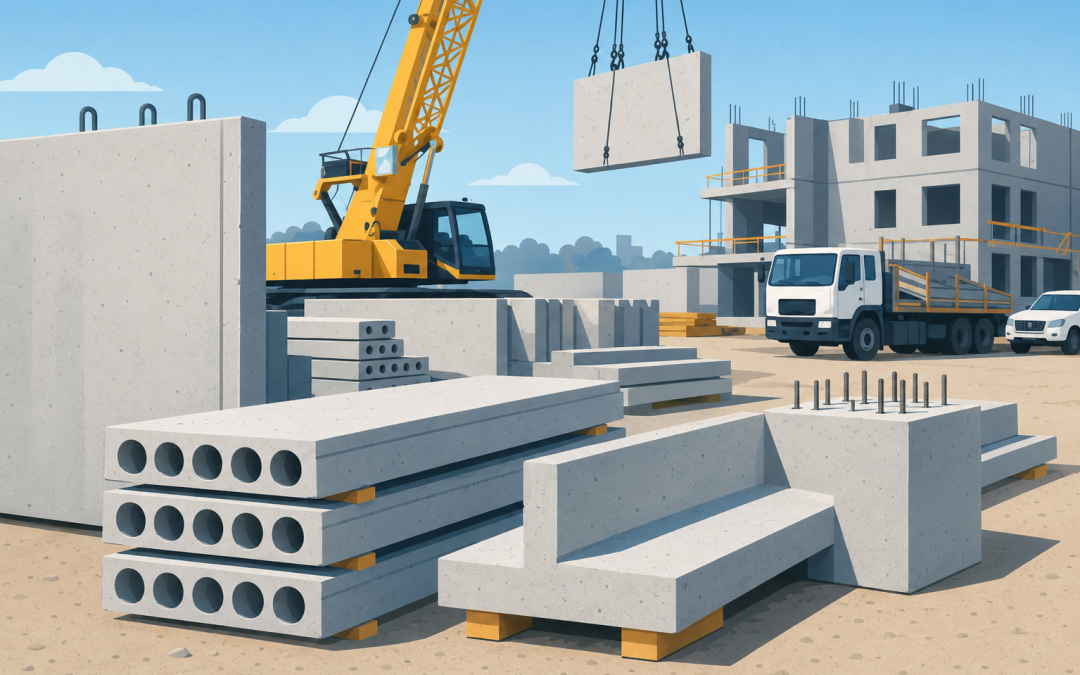
When programme pressure, site access and quality control all matter at once, precast concrete becomes a practical solution rather than a design extra. If you are asking what is precast concrete, the short answer is this: it is concrete cast in a controlled factory environment, then transported to site for installation as a finished structural or architectural element.
That difference in where the concrete is produced has real implications for build quality, speed, labour planning and site coordination. For developers, contractors, architects and project managers, precast concrete is often less about novelty and more about reducing variables that can slow a job down.
What is precast concrete?
Precast concrete is any concrete element manufactured off site in moulds or formwork, cured under controlled conditions, and then delivered to the project ready for lifting and fixing into place. These elements can be structural, such as beams, columns, wall panels and flooring units, or non-structural, such as boundary walls, stair units, cladding panels and bespoke architectural pieces.
This is different from in-situ concrete, which is poured and cured directly on site. With in-situ work, the site itself becomes the production environment. With precast, production is moved into a dedicated facility where dimensions, mix consistency, reinforcement placement and curing can be managed more tightly.
That controlled process is one of the main reasons precast is widely used on projects where repeatability, speed and finish quality are priorities.
How precast concrete is made
The process starts with design and engineering. The element must be sized not only for its final structural role, but also for manufacture, transport and lifting. That is where precast differs from simpler concrete supply. A piece might work perfectly on paper, but still need adjustment if it cannot be safely handled or delivered to site.
Once the design is confirmed, moulds are prepared and reinforcement, inserts or cast-in fixings are positioned. Concrete is then poured into the mould under controlled factory conditions. After casting, the element is cured, finished, checked for quality and prepared for transport.
Because the production environment is controlled, there is less exposure to changing weather, variable site conditions and interruptions that can affect on-site pours. That can lead to more consistent dimensions, surface quality and strength development, provided the manufacturer is working to the right standards and tolerances.
Why contractors and developers use precast concrete
The biggest advantage is usually programme efficiency. While groundworks or other site activities continue, concrete elements can be manufactured in parallel. Instead of waiting for formwork, pouring and curing on site, the team receives components that are ready to install.
That time saving can be significant, especially where repeated elements are involved. Residential blocks, commercial buildings, retaining structures and infrastructure works often benefit because repetition suits factory production.
Precast can also reduce congestion on site. Fewer wet trades, less formwork activity and less material storage can make a site safer and easier to manage. On constrained sites, including urban or access-limited locations, that matters.
Quality control is another major factor. Factory production allows better oversight of mix design, reinforcement placement, dimensional tolerances and finishing. For clients focused on certified quality and predictable output, this is often one of the strongest arguments in favour of precast.
There is also the labour question. Some projects struggle to maintain enough skilled labour on site for large volumes of traditional concrete work. Precast shifts a substantial portion of that effort into manufacturing, where the process is more repeatable and less dependent on changing site conditions.
Common uses for precast concrete
Precast concrete is used across residential, commercial, industrial and civil engineering projects. In practical terms, it appears wherever there is value in producing reliable components off site and installing them quickly.
Common applications include wall panels, retaining walls, staircases, beams, columns, floor units, roof panels, kerbs, drainage products and boundary elements. Bespoke units are also common where standard dimensions do not suit the project.
In the Maltese market, pre-stressed pre-cast roofing panels and custom precast elements are particularly relevant because they support faster project delivery while maintaining structural performance. The right system depends on span requirements, load conditions, handling constraints and installation sequencing.
Architects may also specify precast for visual reasons. Exposed finishes, repeated façade elements and crisp detailing can often be achieved more consistently in factory conditions than on an active building site.
Precast concrete versus cast in-situ concrete
The choice is not always straightforward. Precast is not automatically better than in-situ concrete, and in-situ is not automatically the more flexible option. It depends on the build type, access, scale and design intent.
Precast tends to suit projects with repetition, tight deadlines, predictable geometry and a need for speed on site. It can also work well where weather disruption would create programme risk for large in-situ pours.
In-situ concrete often remains the better option for highly irregular shapes, one-off elements, restricted lifting conditions or locations where transport of large units becomes impractical. If a site cannot accommodate cranes, delivery sequencing or temporary storage, precast may introduce complications rather than solve them.
Cost also needs to be judged properly. The unit cost of precast elements can appear higher at first glance, but that is only part of the picture. Savings may come from faster installation, reduced labour demand, less temporary works and shorter programme duration. On the other hand, bespoke moulds, transport logistics and crane requirements can add cost if the project is not well suited to the system.
What to consider before specifying precast
Early coordination is essential. Precast works best when it is considered during the design stage rather than introduced late as a procurement substitute. Structural design, transport routes, crane access, lifting points, tolerances and connection details all need to be resolved in advance.
Dimensions matter. A panel or beam that is simple to manufacture may still be difficult to move through local roads or install in a built-up area. Weight, length and lifting angle all have an effect on how practical the element will be on the day of installation.
Connections also deserve attention. The performance of a precast system depends not only on the element itself, but on how it interfaces with the surrounding structure. Bearings, grout joints, fixings, reinforcement continuity and movement allowances must be designed and executed correctly.
Specification quality matters as well. Buyers should be clear on strength class, cover, finish requirements, tolerance expectations and certification. For commercial and structural work, dependable supply needs to be backed by technical competence and quality assurance, not just production capacity.
The role of quality control in precast concrete
One of the strongest reasons to choose precast is control, but that only holds true when the manufacturer follows disciplined production standards. Concrete mix consistency, mould accuracy, curing conditions and reinforcement placement all affect the final result.
Certified systems and traceable quality procedures provide confidence that the element delivered to site matches the design intent. For contractors and developers, this reduces uncertainty. For architects and engineers, it supports compliance and predictable performance.
A capable supplier should also understand the wider project, not simply the individual element. Manufacturing is only one part of the job. Delivery planning, handling advice, installation sequencing and coordination with other trades are just as important when programme and structural accuracy are under pressure.
This is where an experienced partner adds value. A company such as B&B Construction, with manufacturing and contracting capability under one roof, can support both the product and the practical realities of getting it installed correctly.
What is precast concrete best suited for?
Precast concrete is best suited for projects that benefit from repeatability, speed, controlled quality and reduced on-site wet works. That includes many structural frames, flooring systems, roof components, retaining structures and bespoke units where consistency matters.
It is especially effective when the project team wants clearer programme planning and fewer variables on site. If access, lifting and coordination have been considered early, precast can simplify delivery rather than complicate it.
The key point is not that precast replaces every other concrete method. It is that it gives project teams another route to achieving structural performance and build efficiency with greater control.
For clients planning new works, extensions, commercial developments or civil engineering projects, asking the right question is not only what is precast concrete, but whether precast is the right fit for this build, this site and this programme. When those answers align, it can be one of the most efficient choices on the job.