
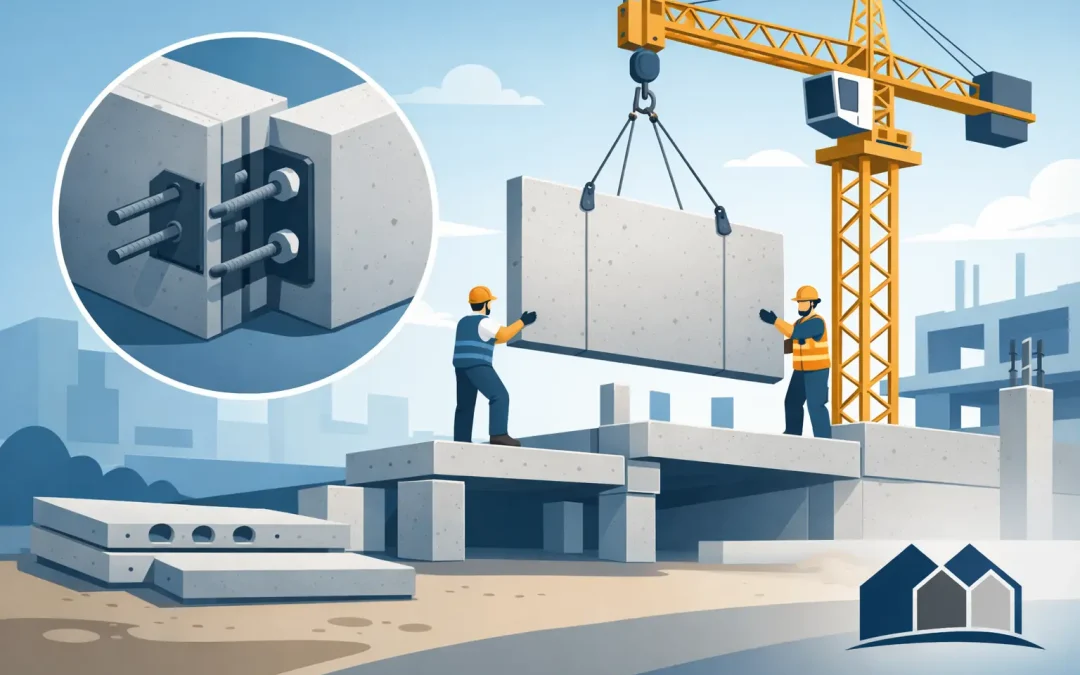
A precast frame can be produced with excellent dimensional control in the yard, but the job is only as strong as the way the elements are joined on site. When clients ask how is precast concrete connected, the real answer is that connection design sits at the centre of structural performance, installation speed and long-term durability.
Precast concrete is not connected by one universal method. Beams, columns, wall panels, stairs, slabs and bespoke units all have different structural roles, so the connection detail changes accordingly. The engineer must account for load path, erection sequence, tolerance, fire performance, movement, corrosion exposure and the practical realities of lifting and fixing each element safely.
How is precast concrete connected in practice?
In practice, precast concrete is usually connected through a combination of cast-in steel components, reinforcement continuity, grout, in-situ concrete stitches and mechanical fixings. Some connections are designed to behave as pinned, transferring vertical load while allowing limited rotation. Others are detailed as moment-resisting or diaphragm connections, where the joint must also transfer lateral forces, shear and continuity across the structure.
The most common approach is to cast plates, threaded inserts, sockets, dowels or projecting reinforcement into the precast unit during manufacture. Once the element is lifted into position, it is aligned, temporarily braced and then fixed to the adjoining component. The final structural connection may be completed by bolting, welding, grouting sleeves, casting a stitch of concrete or tying reinforcement into an in-situ topping.
This matters because precast is assembled, not poured as one monolithic frame. The quality of the finished structure depends on both factory precision and site execution. A well-designed joint allows fast installation while still delivering the required structural behaviour.
Main types of precast concrete connections
Wet connections
Wet connections rely on in-situ concrete or grout placed on site to complete the joint. These are common where continuity is needed between units, such as wall-to-wall joints, beam-to-column joints or floor units tied together with structural topping.
A typical example is a dowel or projecting bar connection. Steel reinforcement extends from one or both precast elements, the units are placed with the required gap or recess, and the connection is filled with grout or concrete. Once cured, the joint provides composite action and can transfer load more continuously than a purely dry fixing.
The advantage is structural strength and continuity. The trade-off is programme time, because curing must be allowed for before the connection reaches full design capacity.
Dry connections
Dry connections are completed by mechanical means, usually bolting or welding steel plates and inserts. These joints are often used where rapid erection is a priority, or where the structural detail is better suited to steel-to-steel fixing.
For example, a wall panel may be fixed to a supporting frame with cast-in plates and welded cleats, or a beam may seat onto a corbel and be restrained with bolted hardware. These systems can be highly efficient on site, particularly where access and sequencing are carefully planned.
However, dry does not mean simple. The connection still needs protection against corrosion and fire, and tolerances must be managed closely. In a marine environment such as Malta, durability requirements are especially important.
Hybrid connections
Many projects use a hybrid arrangement. An element may be initially supported by a dry mechanical fixing, then made structurally complete with non-shrink grout or an in-situ stitch. This gives the installer immediate stability while allowing the final joint to achieve the required performance.
Hybrid details are common because they respond well to real project demands. They allow safe erection, practical adjustment and a durable final connection.
How different precast elements are joined
Columns to foundations
Precast columns are often connected to foundations using starter bars, holding down bolts, pocket foundations or grouted sleeves. In one common detail, the foundation is cast first with projecting reinforcement or sockets. The column is then lowered into place, levelled and grouted.
The choice depends on loading, tolerance and erection method. A pocket foundation can offer some adjustment during installation, while a bolted base detail may support faster alignment. Where moment transfer is required, the joint must be designed accordingly rather than treated as a simple bearing connection.
Beams to columns
Beams are frequently connected to columns by bearing onto corbels, hidden steel brackets or beam seats, with additional dowels, bolts or welded plates to provide restraint. Some beam-to-column connections are intended mainly for vertical load transfer. Others contribute to frame stability and must resist shear, uplift or bending.
This is one of the clearest examples of why the answer to how is precast concrete connected depends on structural intent. Two details may look similar during erection but behave very differently once the building is loaded.
Wall panels to slabs or frames
Precast wall panels can be loadbearing, non-loadbearing or purely architectural. Their fixings therefore vary. Loadbearing panels often use dowels, grouted joints and structural bearings. Cladding or façade panels are more likely to use adjustable brackets, anchors and restraint fixings connected back to the frame.
Panel connections must also deal with movement. Concrete creeps and shrinks, buildings deflect under load, and thermal effects can cause small but significant dimensional changes. A rigid connection where movement is expected can create cracking or distress.
Floor and roof units
Hollowcore slabs, solid planks and pre-stressed pre-cast roofing panels are usually connected through bearings, shear keys, grout joints and structural topping where required. The units may span independently, but they often need tying together to create diaphragm action and distribute loads across the floor or roof.
In these cases, the connection detail is not only about holding one unit against another. It is also about how the assembled surface behaves as a system under service loads, wind action and accidental loading.
The design factors that decide the connection detail
Connection design is not selected in isolation. It must fit the structural scheme, the site constraints and the intended build sequence.
Load transfer is the first consideration. The connection must carry the forces that actually occur, including vertical load, shear, tension and, where relevant, moment. It must also account for temporary erection loads, which can differ from final service conditions.
Tolerance is equally important. Precast manufacturing is accurate, but no site is perfect. Foundations may vary slightly, crane placement may limit lift angles, and adjoining trades can affect access. Good connection design allows realistic adjustment without compromising safety or quality.
Durability must be considered from the start. Exposed steel, inadequate cover, poorly detailed grout pockets or joints that trap water can all shorten service life. In coastal and high-exposure conditions, material choice and detailing become even more critical.
Fire performance also affects the detail. Steel plates, bolts and other embedded components may need protection or sufficient concrete cover to meet project requirements. This cannot be left as an afterthought once fabrication has started.
Installation quality matters as much as design
A well-engineered connection can still fail in practice if installation is poorly managed. Temporary bracing, line and level checks, grout placement, weld quality and curing periods all affect the finished result.
This is why experienced coordination between manufacturing, delivery and site teams is so valuable. When one partner understands the element geometry, lifting points, connection sequence and final tolerances, the process is more controlled. For contractors and developers, that reduces avoidable delays and corrective work.
On larger or more complex schemes, connection planning should be reviewed early with the fabricator, structural engineer and site delivery team. It is far better to resolve access, sequencing and fixing constraints before units arrive on site.
Common problems with precast connections
Most connection issues come back to three causes: poor coordination, unrealistic tolerances and details that do not match site conditions. A connection may work perfectly on drawings but become difficult if access for welding is restricted, if grout cannot be placed properly or if adjacent elements leave no room for adjustment.
Another common issue is treating every joint the same. A stair flight connection, a retaining wall connection and a roof panel connection may all involve cast-in steel and grout, but their performance requirements are not interchangeable.
For that reason, precast should be approached as a coordinated system rather than a collection of individual units. The connection is where design intent, manufacturing quality and site execution meet.
Choosing the right approach
The right connection is usually the one that balances structural performance, speed of erection, durability and buildability. In some projects, that means more in-situ stitching for continuity. In others, it means dry mechanical details to maintain programme. There is no benefit in specifying a highly sophisticated joint if a simpler, proven detail will achieve the same result more reliably.
For clients delivering residential, commercial or civil engineering works, the practical question is not only how is precast concrete connected, but who is taking responsibility for making those connections work as part of the full project. That includes design review, manufacturing control, site coordination and quality assurance.
At B&B Construction, that joined-up approach is central to delivering comprehensive building solutions. When precast elements, concrete supply and site execution are considered together, connections can be planned with fewer compromises and better project control.
If you are assessing a precast solution, focus early on the joints. They are not a minor detail to be resolved later. They determine how quickly the structure goes up, how well it performs and how confidently the project moves from drawing to completed build.